By Andy Worthington
While Rodriguez — like John Yoo, Jay S. Bybee and senior Bush administration officials, up to and including the president — have never been criminally prosecuted, it is uncertain whether, overall, the apologists for torture are winning. Despite their protestations over the years, they have no proof that torture worked.
::::::::
Law-abiding U.S. citizens have been appalled that Jose Rodriguez, the director of the CIA’s National Clandestine Service until his retirement in 2007, was invited to appear on CBS’s 60 Minutes program last weekend to promote his book, “Hard Measures: How Aggressive CIA Actions After 9/11 Saved American Lives,” in which he defends the use of torture on “high-value detainees” captured in the Bush administration’s “war on terror,” even though it was illegal under U.S. and international law.
Rodriguez joins an elite club of public officials — including George W. Bush, Dick Cheney, and Donald Rumsfeld — who have not been prosecuted for using torture or authorizing its use. Instead, they have been writing books, going on book tours, and appearing on mainstream TV to attempt to justify their unjustifiable actions.
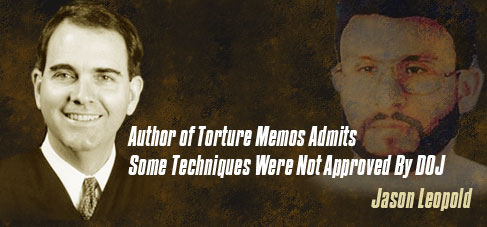
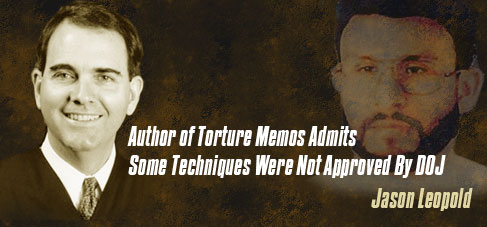
They all claim to be protected by a “golden shield,” a legal opinion issued by the Justice Department’s Office of Legal Counsel crafted by attorney John Yoo. While the office’s mandate is to provide impartial legal advice to the executive branch, the opinion redefined torture and approved its use — including the use of waterboarding, an ancient torture technique and a form of controlled drowning — on a supposed “high-value detainee,” Abu Zubaydah. The opinion came in the form of two memos, dated August 1, 2002, that will forever be known as the “torture memos.”
A four-year internal ethics investigation concluded in January 2010 that Yoo and Bybee had been guilty of “professional misconduct,” which ordinarily would have led to professional sanctions, but a senior Department of Justice official, David Margolis, overrode that conclusion, stating that both men had been under great pressure following the 9/11 attacks, and had merely exercised “poor judgment,” which was the equivalent of nothing more than a slap on the wrist.
No one bothered mentioning that Article 2.2 of the UN Convention against Torture and Other Cruel, Inhuman or Degrading Treatment or Punishment, to which the U.S. became a signatory under Ronald Reagan, declares, “No exceptional circumstances whatsoever, whether a state of war or a threat of war, internal political instability or any other public emergency, may be invoked as a justification of torture.”
And so, this past Sunday, Jose Rodriguez was invited to undertake his own redefinition of torture, essentially unchallenged, and on mainstream TV. Rodriguez brushed off criticism of the use of torture by saying, “We made some al-Qaeda with American blood on their hands uncomfortable for a few days, but we did the right thing for the right reason. The right reason to protect the homeland and to protect American lives.”
As Amy Davidson noted in The New Yorker, he also “bragged about its use in proving the manhood of the torturer,” stating, “We needed to get everybody in government to put their big boy pants on and provide the authorities that we needed,” and he “talked as if torture were an expression of strength, rather than momentary domination masking the most abject moral and practical weakness.” For Glenn Greenwald, the reference to “big boy pants” exposed “a whole new level of psychosexual creepiness.”
On specific techniques, Rodriguez defended the use of waterboarding by saying, of Khalid Sheikh Mohammed, who was subjected to waterboarding 183 times, “I don’t know what kind of man it takes to cut the throat of someone in front of a camera like that [a reference to KSM’s unproved confession that he personally killed U.S. journalist Daniel Pearl], but I can tell you this is probably someone who didn’t give a rat’s ass about having water poured on his face.”
He also defended the use of physical violence and nudity by pointing out, “The objective is to let him [the detainee] know there’s a new sheriff in town and he better pay attention,” compared sleep deprivation to “jet lag,” and, reflecting on the use of “stress positions” over many hours, said, “I was thinking about this the other day. The objective was to induce muscle fatigue, and most people who work out do a lot more fatiguing of the muscles.”
At another point in the interview, Rodriguez made reference to the psychologists — including James Mitchell and Bruce Jessen — who had worked on the U.S. military’s program for using torture to train U.S. personnel to resist interrogation if captured by a hostile enemy, which was reverse-engineered and provided the basis of the torture program in the “war on terror.” Their particular contribution was to emphasize that detainees must be broken down to a state of “learned helplessness” (a concept developed by U.S. psychologist Martin Seligman in the 1960s), in which all resistance is futile and the detainee becomes completely dependent on his interrogators. Speaking of that, Rodriguez stated, “This program was about instilling a sense of hopelessness and despair on the terrorist, on the detainee, so that he would conclude on his own that he was better off cooperating with us.”
To be spouting all of the above on mainstream TV without, essentially, any comeback from the host, Lesley Stahl, or from those who should be enforcing America’s obligations to prosecute torturers, is depressing enough, but it was not all that was wrong. Rodriguez also spoke openly of the crime for which he is most generally known — the destruction of 92 videotapes that contained the “interrogations” in Thailand of Abu Zubaydah and Abd al-Rahim al-Nashiri, another “high-value detainee” who was waterboarded. As Glenn Greenwald explained last week,
“At the time the destruction order was issued, numerous federal courts — as well as the 9/11 Commission — had ordered the U.S. Government to preserve and disclose all evidence relating to interrogations of Al-Qaeda and 9/11 suspects. Purposely destroying evidence relevant to legal proceedings is called ‘obstruction of justice.’ Destroying evidence which courts and binding tribunals (such as the 9/11 Commission) have ordered to be preserved is called ‘contempt of court.’ There are many people who have been harshly punished, including some sitting right now in prison, for committing those crimes in far less flagrant ways than was done here. In fact, so glaring was the lawbreaking that the co-Chairmen of the 9/11 Commission — the mild-mannered, consummate establishment figures Lee Hamilton and Thomas Kean — wrote a New York Times op-ed pointedly accusing the CIA of ‘obstruction’ (‘Those who knew about those videotapes — and did not tell us about them — obstructed our investigation’).”
As with John Yoo and Jay S. Bybee, Rodriguez was never punished. An investigation into the destruction of the videotapes began under Bush, and continued under Obama, but in November 2010 the Department of Justice announced that the investigation would be closed without filing any charges. As Greenwald explained, Judge Alvin Hellerstein, who had ordered the CIA to preserve and produce the tapes, “refused even to hold the CIA in contempt for deliberately disregarding his own order.” Instead, he “reasoned that punishment for the CIA was unnecessary because, as he put it, new rules issued by the CIA “should lead to greater accountability within the agency and prevent another episode like the videotapes’ destruction.’”
However, while Rodriguez — like John Yoo, Jay S. Bybee and senior Bush administration officials, up to and including the president — have never been criminally prosecuted, it is uncertain whether, overall, the apologists for torture are winning. For them to succeed in persuading enough ordinary Americans that criminal laws don’t actually apply to the U.S. president, or anyone working for him, they also need to establish that torture kept America safe. On that front, despite their protestations over the years, they have no proof that torture worked.
In his interview, Rodriguez wheeled out the tired old lies about torture’s leading to the capture of “high-value detainees.” In a moment of courage, Lesley Stahl mentioned well-established claims that Abu Zubaydah’s torture had led operatives on countless wild-goose chases, to which Rodriguez replied, “Bullshit. He gave us a road map that allowed us to capture a bunch of al-Qaeda senior leaders.” In contrast, of course, former FBI interrogator Ali Soufan pointed out last year that torture did not yield important leads, and that, for example, information from Abu Zubaydeh pointing to Khalid Sheikh Muhammad’s central role in the 9/11 attacks came before the CIA’s torturers took over his interrogations.
Soufan also pointed out the difference between torturers and skilled interrogators, which CNN described as follows:
“‘There is a difference between compliance and cooperation,’ he said. Compliance can result from torture — a detainee will do anything to make the rough treatment end. But real cooperation, says Soufan, comes from engaging the detainee after learning everything possible about them.”
Torture’s apologists always want to deny the importance of skilled interrogators, who conduct extensive research on their subjects and often spend a long time building up a rapport with them.
In Rodriguez’s case, he also resorted to claims that torture had led to the capture of Osama bin Laden. He told Dana Priest of the Washington Post last week, “I am certain, beyond any doubt, that these techniques, approved at the highest levels of the U.S. government, certified by the Department of Justice, and briefed to and supported by bipartisan leadership of congressional intelligence oversight committees, shielded the people of the United States from harm and led to the capture and killing of Osama bin Laden.”
In response, Sen. Dianne Feinstein (D-Calif.), the chair of the Senate Intelligence Committee, and Sen. Carl Levin (D-Mich.), the chair of the Senate Armed Services Committee, issued a joint statement (PDF) condemning the remarks made by Rodriguez and others who had leapt on the bandwagon as the anniversary of bin Laden’s death approached. In their statement they said that such remarks were “inconsistent with CIA records” and “misguided and misinformed,” and they expressed their disappointment that “Mr. Rodriguez and others, who left government positions prior to the OBL operation and are not privy to all of the intelligence that led to the raid, continue to insist that the CIA’s so-called “enhanced interrogation techniques’ used many years ago were a central component of our success.”
Their statement, as the New York Times explained, “rebutted various claims that critical information about bin Laden’s courier” came from Khalid Sheikh Mohammed or from Abu Faraj al-Libi, another “high-value detainee” seized in Pakistan in 2005 and held at Guantánamo since September 2006 like Khalid Sheikh Mohammed and 13 other “high-value detainees.” In addition, the Times noted that the statement “rejected claims that tough treatment drew valuable information about bin Laden’s courier from a third detainee, unidentified in the statement,” but elsewhere identified as Hassan Ghul, another “high-value detainee,” who was seized in Iraq in 2004 and who was never held at Guantánamo. The statement noted, “While this third detainee did provide relevant information, he did so the day before he was interrogated by the CIA using their coercive interrogation techniques.”
“Instead,” according to the Times, Sens. Feinstein and Levin stated, without elaborating, that “the CIA learned of the existence of the courier, his true name and location through means unrelated to the CIA detention and interrogation program.”
That is important, but what is needed now is for the Senate Select Committee on Intelligence to complete its comprehensive review of the CIA’s former detention and interrogation program and publish it. As the statement also explained, “Committee staff have reviewed more than 6 million pages of records and the Committee’s final report, which we expect to exceed 5000 pages, will provide a detailed, factual description of how interrogation techniques were used, the conditions under which detainees were held, and the intelligence that was — or wasn’t — gained from the program.”
As Dan Froomkin explained in the Huffington Post last Monday, the investigation by Democrats, which has taken nearly three years and in which Republican lawmakers have refused to take part, “concludes that records from the Bush administration fail to support claims that torture was effective in stopping any terrorist attack” or in leading to the discovery and killing of Osama bin Laden last year.
While people such as Jose Rodriguez remain free to peddle their nonsense about torture, and to profit from it, America’s name continues to be tarnished and the American public continue to be shamefully misled. The long-awaited report into the CIA’s torture program should be published as soon as possible to let people know what really happened and, one hopes, to play a part in tearing down the “golden shield” that has so far protected Bush administration’s officials from prosecution.
Submitters Website: http://www.andyworthington.co.uk
Submitters Bio:
Andy Worthington is the author of “The Guantánamo Files: The Stories of the 774 Detainees in America’s Illegal Prison” (published by Pluto Press), as well as and “The Battle of the Beanfield” (2005) and “Stonehenge: Celebration and Subversion” (2004). He is also the co-director (with Polly Nash) of the documentary film, “Outside the Law: Stories from Guantánamo.” Visit his website at: www.andyworthington.co.uk.